The Reckless Dustup Over Jerry Almonte’s Lindy Hop Project and Why You Shouldn’t Let It Deter you from Participation

Preface: This post contains glancing discussion of Max Pitruzella, who has been credibly accused by multiple people of horrifying sexual assault and violence. It contains no new information, but stay clear if you don’t want his name in your ears.

Friend of the Ballroom Jerry Almonte has been around documenting the obscure, complicated, troubled corner of American art that is the national Lindy Hop scene for more than two decades now. When he went around soliciting nominations for the best Lindy Hop videos of the 21st century, my immediate response was: “Why, Jerry, would you ever subject yourself to what will become a discussion about every issue imaginable except for the videos? Why would you open yourself up to criticism from a bunch of people who will not contribute, and will then criticize you after the fact? Don’t you understand what the internet is? Are you trying to raise my blood pressure? Why!?”

Jerry hates me passionately, so he did it anyway, and I’m sad to say I was right. Inviting comment on the internet is not for the faint of heart, and sane people/people of goodwill had to watch as righteous folks who hadn’t bothered to nominate any videos insisted that the wrong videos had been nominated. When Jerry extended the nomination period so that the righteous might chime in, the righteous declined, preferring rather to be seen objecting than to contribute meaningfully to anything ever. This is, in my experience, the nature of the righteous. It is condemnation enough to say that these people are most often found on the internet and that it is their proper home. Little else need be said about folks who thrive on reactive debunking.

Another set of people used Jerry’s invitation as an opportunity to object to one video in particular, a multi-couple contest in which Max Pitruzella danced–a man who has been repeatedly and very credibly accused of sexual violence. This is trickier. The video was nominated in spite, not because, of the man’s performance–which seems to me to match his loathsome character–and was prefaced by the usual caveats. But one is not surprised that some people didn’t want to see anything that contained footage of this man.

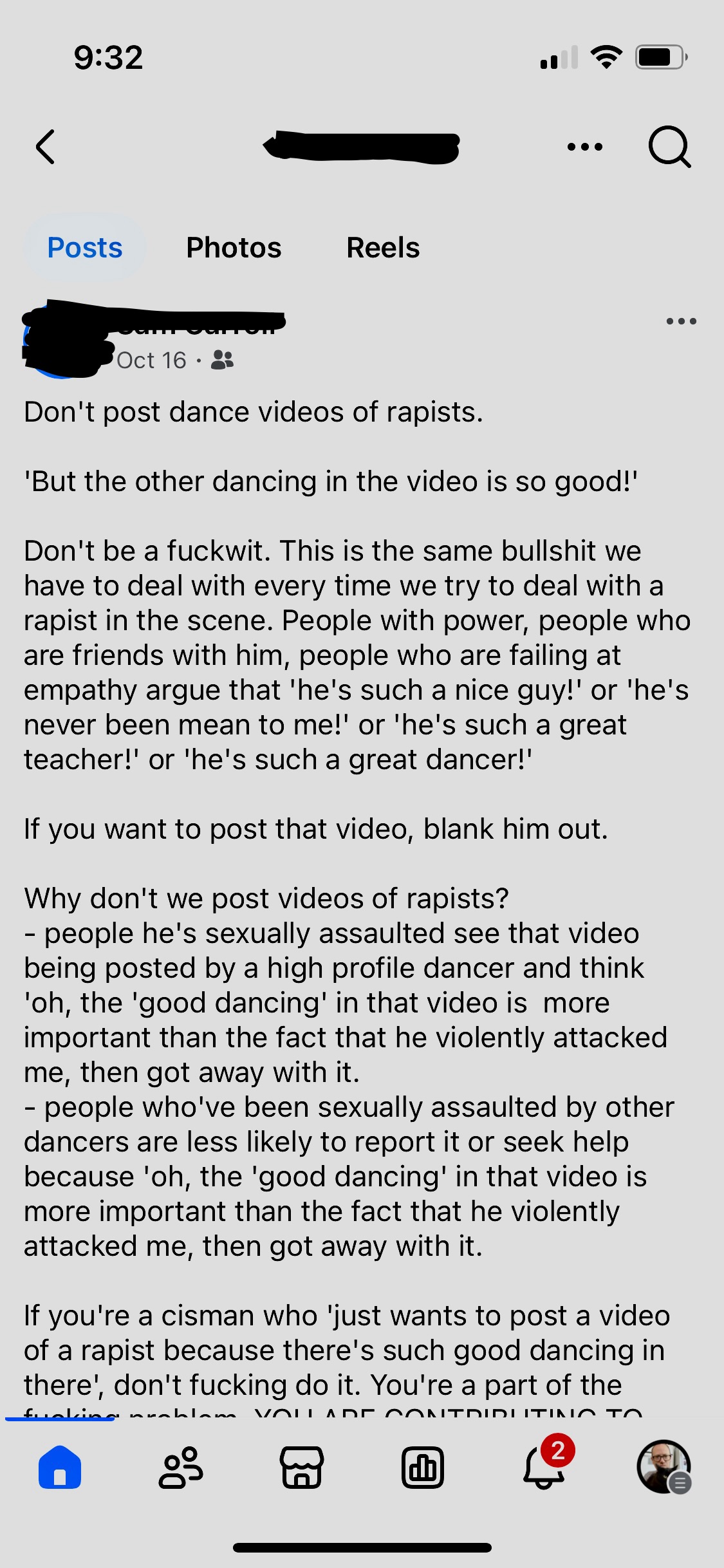
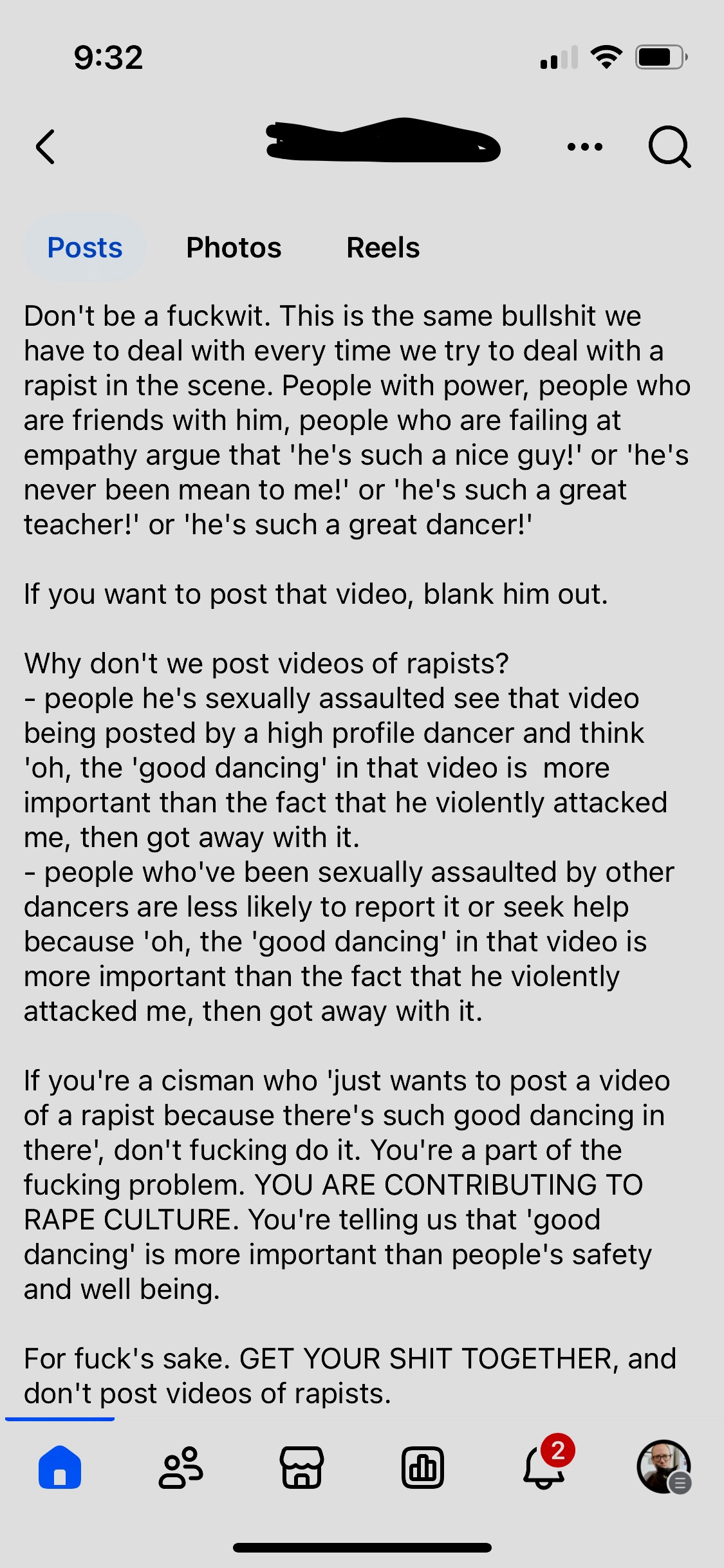
The actual conversation that ensued, however, left me deeply disappointed in the Lindy Hop community and deeply concerned that we have abdicated any responsibility to think through an issue in favor of a preference for howling displays of pompous hieratic certainty. Here’s an example (I’ve blacked out names because I’m not trying to trash people; I’m trying to highlight a kind of discourse I find obscene):

Screenshot
Screenshot

This screed is particularly offensive to me not because everything in it is wrong–quite a lot of it is technically right–but because, while Jerry is very clearly the cause of this invective, very little of it is in response to what Jerry actually did. It lumps him in with a bunch of hideous perspectives that he would never countenance, confidently trashes those perspectives, and leaves the casual reader with the assumption that Jerry is operating some kind of dance rapist rehabilitation media firm.

This is a common rhetorical move in activist-adjacent circles now. You assert a connection between what someone has actually done and a constellation of other behaviors the average person would rightly find reprehensible. You then speak out with great boldness and condescending internet imperatives (“Don’t be a fuckwit,” “GET YOUR SHIT TOGETHER”) against that constellation of behaviors while garnering support and applause. The actual argument made by your victim is irrelevant, because an unquestioned link between it and the worst things possible has been established.

This manner of proceeding is lazy, destructive, and dishonest. It has the further deficit of laundering spite and falsehood by imposing a veneer of straight talk and hard truths on nonsense. The “cis man” bit was truly odd. It seems unlikely that the exhibition of a woman (cis or otherwise) interested in sharing or viewing this video would change the author’s position, nor do I suspect that the author checked the gender identities of the people who nominated the video. The author is assuming all of this, because, in this conversation, they have a theory of the world that is true by definition and a script ready to impose for any occasion.

As it happens, I have chatted over the years with the person who wrote this, and I like them. I do not believe that the lazy, trashy, totalizing response they have written here represents them or their gender, nor do I believe it invalidates all of their other ideas. I am, however, quite confident that here the author is doing Jerry a severe injustice in an attempt to score points against something that isn’t actually happening. I felt a familiar chill reading this, and it took me a minute to figure out why. The posture of certainty and the confidence in the right that allows the author to beat on Jerry with whatever stick is closest to hand reminds me of the psychotic religious training of my youth. This is the practice and logic of fundamentalism warmed over and appropriated by the left. I am uncomfortable with the number of people I know and care about who are now in engaging in this kind of language.

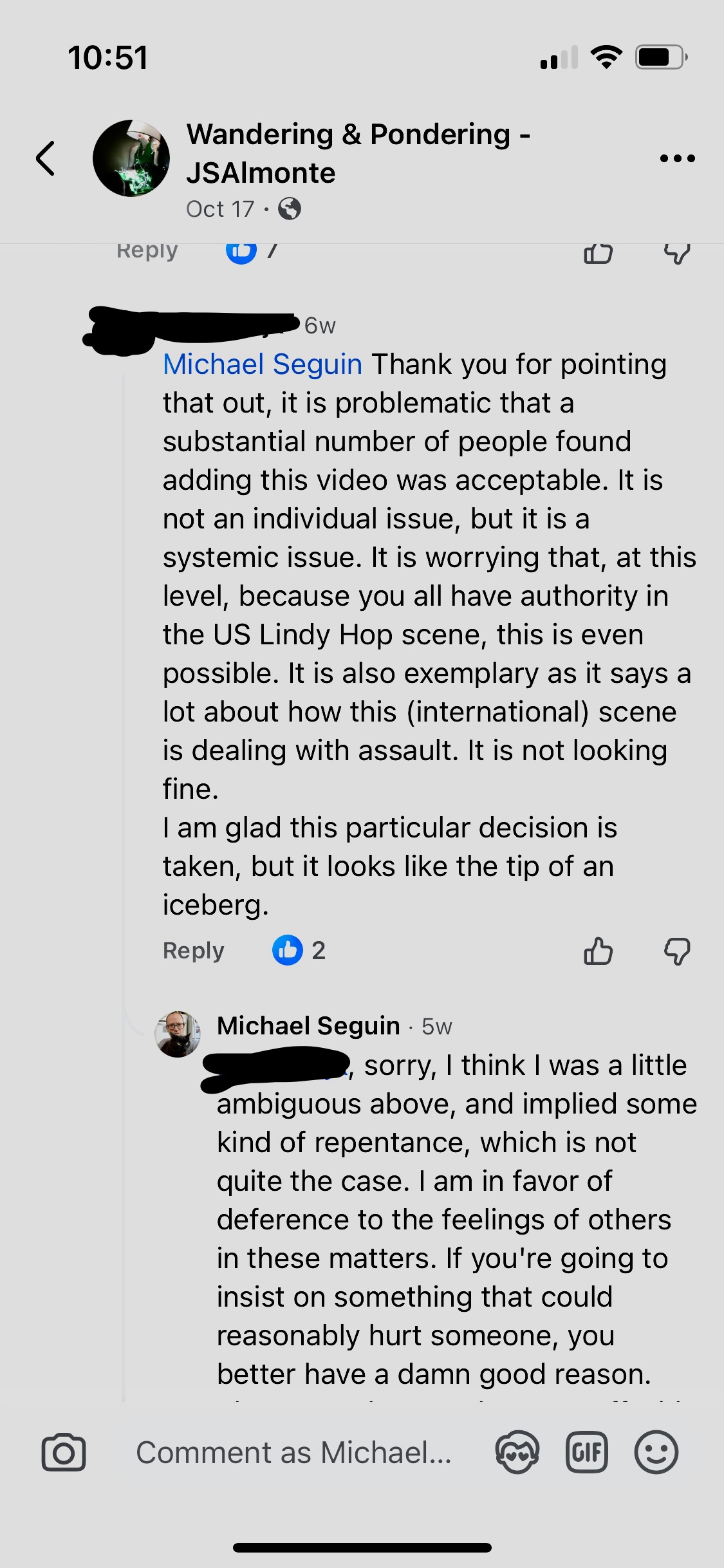
Here’s another example. As misguided critiques piled up on Jerry’s facebook page Wandering and Pondering, I took the opportunity to observe that it wasn’t quite fair that he should take all the hits on this when a bunch of us had nominated the video. He was, at most, guilty of an editorial lapse, whereas the rest of us were–in the terms of this argument–guilty of intentionally platforming a rapist. I was in earnest, but I was also wryly attempting to point out that the people criticizing Jerry didn’t really seem to know precisely what was going on.

The person I was addressing mistook this as an expression of remorse on my part:

Screenshot

At this point it will be useful to remind the few readers who are still with me of what Jerry actually did. Finding that the video of the 2006 Ultimate Lindy Hop Showdown “Liberation” finals, which has 10 million views on youtube, was receiving more votes in its category than any other, he duly put it in his lineup after making special mention that it included, amongst 9 other people, a man whom all of us should abhor. He linked to victims’ accounts. None of this lionizes Max Pitruzzella and none of it expresses the slightest desire to rehabilitate him or even the slightest regard for his dancing. It is a simple acknowledgement that one of the most watched Lindy Hop videos of all time–which is publicly available and often near the top of any google search for “Lindy Hop”–is in fact worthy of consideration in any kind of “best of” list, particularly when everyone has been voting for it.

There are reasonable terms on which one could disagree with the video’s inclusion, but that inclusion in no way indicates some rot at the core of American Lindy Hop leadership. It indicates a difference in opinion. It is concerning that discussion about such things cannot take place in any but the most catastrophizing terms. When everything one disagrees with needs to be spun up into a world historical wrong perpetrated agains the most vulnerable in order to gain a hearing, something has gone off track in our thinking.

Not everything justifies extreme treatment or anything close to it. The insistence on pretending that every moral stance is obvious makes people take stupid positions. All of us listen to music and take in art made by wicked and violent people. Throw a dart at a member of the jazz band of your choice, google the person it landed on, and see what happens. All of us engage in moral parsing to negotiate our way through the world. Some of the most outspoken people I know on the internet work for companies bent on destroying society and the environment for a temporary profit. All of this is fair game for criticism and discussion. None of it is obvious, and pretending that it is leads in the end to exhausted cynicism.

I am fine with the removal of this video. I am not fine with how it happened or the assumptions that many of us watching let go unchecked. A reasonable person might contend that I have no business speaking about any of this, because I am not a rape victim, which is true. I sure as hell do know what it’s like, however, to watch people praise and elevate media in which your abuser appears, because it has been happening to me in this project. I responded to the person in my second example with the following, which I will quote at length, because I like what I’ve written and stand by it (again, I have edited out names, because I’m not trying to pick on people):

…sorry, I think I was a little ambiguous above, and implied some kind of repentance, which is not quite the case. I am in favor of deference to the feelings of others in these matters. If you’re going to insist on something that could reasonably hurt someone, you better have a damn good reason. That’s not the case here, so off with the video.
Otherwise, this whole thing is vexing on a number of levels. I am disappointed by strident people who can’t be bothered to pay close enough attention to determine where to direct their anger (this is not the case with you–you quoted me). I’m grossed out by the people who nominated this and then stayed very quiet while Jerry got treated like he scoured the internet for rapists to promote. To change your mind is fine. To apologize is fine. To take responsibility in some other way or to argue the point is fine. To be cowed by the mere loudness of the gale of moral certainty is base.
Perhaps that is ungenerous–some of my fellow nominators may simply be unsure of how they now feel, which is a decent and human position. I wish more people were willing to express it.
I’m mortified at the bad faith conflation of arguments on behalf of the other dancers in the video with an argument for rehabilitating Max (one of the most worthless and destructive men in Lindy Hop), an argument no one in the conversation is making. There is no sense, and less justice, in rounding people up to rape apologists when they are not, in any sense, apologizing for rape. I acknowledge that I’m pulling criticisms from a couple of different pages rather than responding exclusively to you. I made the mistake of looking around…when you wrote, “I am glad this particular decision is taken, but it looks like the tip of an iceberg,” you put your finger on why I find all of this misguided. I know Jerry well, and one of the darkly comic aspects of this discussion is that I’ve watched him, for the better part of two decades, consistently put himself forward on behalf of any piece of justice you care to name. I was around when women exposed Max for what he is. Jerry was working for an event, quietly and insistently striving to make sure that Max and his weird little fascist buddies were banned for good. This at a time when a good many people (people now graced by vocal and retroactive certainty) were hemming and hawing.
I have been knee deep in these disasters for most of my adult working life. I have been physically and legally threatened by people I’ve kicked out. I have gone to court with women to seek restraining orders. I have been harassed by two men through multiple channels for years, because I removed them from our community. I have consulted with multiple organizations on codes of conduct and with multiple events on specific abusers. My business partner and I have poured effort and money into this for years. Like many others, I have lost friends, opportunities, and vast tracts of time fighting abusers and assaulters in the Lindy Hop scene. That’s your job if you run these spaces, and in a lot of ways it’s an honor. But it’s also a stone cold bummer when people on the internet use reductive and not-at-all obvious metrics like this to render judgement from afar.
What I just described is the reality of the iceberg you reference. The majority (though not all) of the community leaders still standing in the American Lindy Hop scene are standing because they have been beat to shit in these battles, and they can display their wounds on request. I know that people can easily slide into a ritualized habit of debunking and problematizing, as the procedure is accorded automatic respect. It’s a bad habit, and needs to be addressed in this community.
I abhor the insistence on a categorical rule in these matters. It feels virtuous, and it is not. It forces people into absurd contradictions and indefensible positions and leaves them stranded there.
e.g. For Christ’s sake–and I can’t believe I have to point this out–there is another notorious abuser in this lineup–mine. She’s in both the Silver Shadows videos and in the Mad Dog video. I actually nominated the latter. Her behavior is public knowledge to many of the people viewing and nominating this stuff, and she has been positively mentioned in the comments. This person tortured me for years; embezzled $50,000; put me on the hook for her tax fraud; framed our employee for her own theft of cash; stole from at least one other dance organization; slandered and belittled any woman she perceived as a threat to her attention in the community; and, when I objected to having a child before we put our financial house in order, sounded her friends about the feasibility of sabotaging birth control. I was saved from suicide by the discovery of her crimes, which gave me a hint of a way out.
If you’d like a link to my public discussion of this, I will furnish one.
The point of this long digression is to say 1) that I’m disinclined to credit the seriousness of an approach which treats the removal of a video in which Max appears as a high moral imperative while passing entirely over the woman who abused and terrorized me and this community for years and 2) it is very obvious to me that not all victims require or would even desire a blanket ban on any video in which their abuser appears–I know this because I am a victim and do not require or desire it. For my part, I think the videos she is in are important in the modern history of Lindy Hop (such as it is), and I would not feel comfortable suppressing them.
No one else she injured is required to feel the same way, but, when I take a position on these things I’m not just some dude talking out of his ass.
Anyway, I am more than willing to forego videos with this rapist in them out of simple consideration. I object, in the deepest sense, to blanket prohibitions of any kind in these matters or to the suggestion that disagreement with a particular group’s orthodox commitment to those prohibitions is a sign of problematic icebergs, complicity with rape culture, etc. Much of the conversation I watched unfold smacks of what happens when activism and advocacy sour into secular religion.
I encourage you and some of the other folks who jumped at this so quickly to reconsider. I don’t doubt the decency of your motivations, but I do think that you’re falling into an untenable trap, which will lead that you on a regrettable internal affairs snipe hunt. Beset as we all are with abominations and unspeakable horrors, there’s little sense in mistaking our natural friends for villains.

The response to this was silence. It didn’t surprise me, but it did disappoint me. My interlocutor was happy enough to step forward boldly and express a blanket criticism of people they knew nothing about using the standard slate of tortured buzzwords. When I responded with details, personal experience, and argument, they said nothing. This complete lack of depth, I think, characterizes most of the passionate writing one encounters in these situations.

I’ve written all of this to vent my spleen a bit, sure. But I’ve also written it because I know I’m not alone in thinking that the response to Jerry was histrionic, misdirected, and irresponsible, and that he is owed an apology, or at least does not deserve to have the callousness and stupidity some of these people attributed to him hung around his neck. I know I’m not alone, because people who don’t want to be yelled at by self-appointed arbiters online keep telling me how much they disliked those ghastly proceedings. They should have the courage to pipe up.

More importantly, while I advised against Jerry’s insane project, I think it has real value and interest. This collection of the most popular performances in 21st century Lindy Hop may say any number of things about us (Where are all the black people? Can Frida possibly be this good? Would I trust any of these people to borrow my car? What happened to regional styles?), and some of it may not be entirely comfortable. But it is surely worth a long look. Most people right now are too busy covering their left flank to put any effort into a real project. Jerry is not, and we need more people like that. Go check it out and vote.

This Endorsement Did Not Have the Intended Effect

I wrote this and posted it on social media shortly before the 2024 presidential election. Looking back on it, I’m disappointed by how often I slip into the prissy, lecturing tone of the very discourse I’m criticizing. Social media really does exert an enormous force in the direction of the twee and the knowing. Still, despite its shortcomings, this seems right to me. I have grown only more convinced that my generation–whatever injustices we have experienced compared to our parents–needs to find a way to look to the future and take care of the kids. Age-based interest groups are mad in a peculiar way: you are lobbying against either who you once were or who, with any luck, you will someday be.

I’m voting for Kamala Harris, because I do not want to hand the United States government over to a crew of Christian Nationalists and authoritarians using Donald Trump, one of the most corrupt people on earth, as their stooge and protector. Harris is not the best candidate in the world–I could name 10 politicians I would prefer off the top of my head–but I think she will hold the line on a great many things I care about, which the other side will actively seek to destroy. That’s politics. It’s a disaster that sometimes the best you can do is keep from losing ground, but disasters are a reality of life. If we can get her elected, then we can go apeshit holding her accountable.

Some people I love and admire plan to withhold their vote or, in some rather weird cases, vote for Trump or that self-serving lunatic Stein in protest. As a practical matter, this seems to me all in service of Trump’s election. I tend to think that electing authoritarians because one considers the current crop of democrats insufficiently progressive is a counterintuitive strategy at best. Reasonable people may differ, though I am sometimes not sure how.

Anyways. That’s my position on this election, for what it’s worth. It is not a particularly complex situation: sometimes the simple ones are the hardest to swallow, as they remind us how very hemmed in we are. I try to keep my feelings out of voting, though not out of politics. What follows below is a much longer screed I’ve been writing on my phone when I have a spare moment. Think of it as footnotes for those interested in further reading. Maybe it is of use to some folks on the fence.

——–

I have noticed lately that the people whose opinions and judgement–political or otherwise–I trust the most have grown quiet. This struck me as strange, and what struck me as stranger was that, upon reflection, I found that I, too, had stopped expressing most opinions.

I think that I’ve grown weary of battling with people on my own team and particularly weary of endless semantic discussions, zero-sum debates, and, above all, of attempting to measure up to shifting purity tests, imposed, as often as not, by privileged people on behalf of the disenfranchised. It’s all very demonstrative, and so many people I know have become the human equivalent of snapping instead of clapping that it has seemed best to me to have political conversations in private, amongst a small handful of friends.

But this too wears thin, can seem a little self-indulgent–is not even, in a meaningful sense, politics at all. One of the sad parts of the left splitting into uncommunicative contingents is that one never has a chance to really present or challenge one’s ideas. The onslaught of jargon and memified twitter-style responses is so instant and so predictable–all of the best propaganda inculcates reflex rather than reflection–that one begins to make mistakes simply because one’s opponents have become zombies. The capacity to see something from a unique angle or to engage meaningfully with the orthodox leftism of the moment has fled the field, so one’s discussions always end, like tic-tac-toe, in a stupid and unproductive draw.

There’s an election tomorrow, and I thought it might be useful to publicly state some of the things that matter to me right now, culturally and politically and to demonstrate the baseline courage of honesty. I do not claim most of this as gospel truth, and I hope to change my opinion when the facts change or my perspective broadens, but this is how I’m approaching the election and the life of a citizen in America more generally at this precise moment.

1) It’s about the kids. Since the boomers, each generation has been shafted pretty hard as the stability (for some) of the 90s gave way to the post 9/11 shitshow and every vile compromise since. I lost years by graduating into the recession. Millennials younger than me don’t really remember anything other than disorder and chaos in America. They have no reason for hope, and they have been trained by Instagram and the like to lionize spiritual prostitution. The newer crop of adults are so phenomenally traumatized by a pandemic-robbed youth and decreased opportunities across the board that they can barely function (and who can blame them). They have retreated into an endless taxonomy of their identities, that being the last sphere over which they have any control. It’s a mess.

All of this can understandably lead to a “I need to get mine” kind of politics, the fruits of which we see in the resentment-based mania of the right. This is a bad basis for voting and a bad basis for thinking. None of us are getting lost years back, and this is not historically unprecedented, by which I mean that we should calm down a bit. Most of us haven’t had to fight in a war, which is damn fine luck in the context of the 20th century. I’ll take a little bit of disillusionment to be born now and escape the mustard gas, thanks very much. What matters, I think, going forward is that the kids working through the system now have some kind of future. An education not based on job training. An open vision of life with options for dignity and meaningful contribution. A sense of justice and integrity. Perhaps some of us could undertake to model a few of these virtues.

2) Precisely because it’s about the kids, adults have a responsibility to respect and make way for the passion and intensity of youth without abdicating the responsibility to exercise judgment. So many of the adults I know live in such terror of falling on the bad side of youth justice movements that they spend their lives chasing the approval of a demographic that, by definition, lacks experience and wisdom. Young people need room to tangle with radical ideas without the adults reflexively and immediately implementing them. If the most intense impulses of my youth had been applauded and aided by the adults in my sphere, I would have done great damage to myself and others, and that damage would have been the adults’ fault. So many of the failures of the left since the pandemic have been the result of well-meaning grownups treating important philosophical conversations instigated by the young as blueprints for immediate policy. Nothing works well this way, and, as boring as deliberation is–and as much as it undercuts the Manichaean impulse towards purity characteristic of the young–we need it to make sure that fresh, important ideas ideas transcend mere slogans and find their way to actual policy.

My conviction that adults need to stop instinctively deferring to the intensity of youthful belief is a reason for my writing all of this. I don’t share the aesthetic obsessions or many of the basic assumptions of the progressive left, though I share almost all of its goals. I know a lot of people like me who roll their eyes at the contradictory statements and the ever-burgeoning terminologies (all recycled) and say nothing. We should probably stop doing that. Sometimes the kids, being kids, will call us painful names. That’s what they do, and we have a responsibility to care about them even when they’re being dicks. For we, too, were once dicks.

3) Global Warming, Climate Change. This is the kids again. Every 10th of a degree we keep the world from warming saves untold lives and prevents untold future suffering in terms of refugees, war-torn nations, and all the rest. We do not acknowledge often enough that real progress has been made, and that the outlook would be far grimmer were it not for the policies of recent years and decades. It’s going to be bad no matter what, but there’s a big difference between “bad” and “unlivable wasteland/Cormac McCarthy novel.” We do not have the right to despair on behalf of future generations. They deserve the best shot we can give them, even if–and this is the hard part–it is not as good as what we have been taught to expect for ourselves. We can’t hang our disappointment around their necks.

4) I will make common cause with anyone of good will, however stupid or amateurish they may be. If they don’t understand trans people or black hair or whatever, I’m not going to send them to Google (how, by the way, has it become an acceptable liberal burn to refer people with honest questions to a search engine run by a giant, wicked corporation?). I don’t say that this should be expected of the relevant black or trans person, although those folks show grace and forbearance often enough in explanation; what I mean is that I’m not going to pretend to be too important or too busy to talk honestly to someone who wants to talk honestly to me. That’s what community is. It is very reasonable for black people, for example, to grow tired of representing their community and fielding questions. Too often, however, this leads white people, straight people, whatever people to feign similar exhaustion. At some point someone has to care about people who aren’t already on the team or who are too busy living, working, or raising children to be on the cutting edge of social justice issues. That should be most of us.

5) The personal isn’t always political, or at least we should strive for a situation in which it is not. Politics should serve the ends of human life, and if those ends are not love, joy, death, grief, shenanigans, and daily human interaction they are nothing. When we make it impossible for people to get through a simple dinner without correction or, in our enthusiasm for ideological rigor, we end up arguing for positions that would reduce daily life to a kind of perpetual political war (all heterosexual sex is rape, as one well-intentioned feminist told me), we are not freeing people–we are telling them that they will always be enslaved. We are robbing them of the basic consolations of humanity. Theoretical frameworks have a habit of turning thought experiments into shibboleths. We don’t need fellow ideologues. We need people with a rough sense of justice and decency and a willingness to learn. I will not seek to enforce theoretical jargon that will be out of fashion by the time it is fully learned. This is cruel. People have to live, and, more often than not, the old words are still the best words.

6) Speaking of language, for the sake of our own brains, we need to pause before taking familiar and useful concepts and reframing them as academic abstractions, particularly when addressing audiences not versed in academic horseshit or who find academic horseshit off-putting (if the only way forward culturally is through advanced degrees and proliferating lingo, then we are doomed). For my money it is often easier–not to mention far more intelligible–to talk about racism or anti-semitism in terms of “original sin” than it is to talk about “systemic injustice.” There are entire swaths of America for whom the distinction would be both richer and more accessible. We speak Academese not for precision, but because we like to hear complex-sounding language come out of our mouths. It is a very harmful form of vanity. George Orwell’s Politics and the English Language will change your life in this matter, and it should be required reading for everyone on the left and everyone who has ever taken a gender studies class (or, God help me, a “literary theory” class).

7) Netanyahu is a war criminal, and the Israeli government is filled with far-right religious lunatics who have no place in civil government and should spend the rest of their lives dead (if you believe in capital punishment) or in prison (if you do not). The United States has the right and the moral obligation to use its financial and military support as leverage to roll back settlement and stop the indiscriminate and cynical slaughter of civilians in Gaza.

8) At the same time, the United States should not abandon Israel, which abandonment is often the real (and rarely honestly stated) goal of those who want us to pressure the Israeli government. It makes no sense that, of all peoples, the oldest and most persistently persecuted should be the only one with no right to a home. It is wrong-headed and dangerous, moreover, to confuse authoritarian religious groups such as Hamas with progressive freedom fighters. The love for Islamic fundamentalism on the left has never ceased to confuse me. People who would consider a moderate evangelical who believes in free speech a mortal enemy manage to fetishize extremist religious psychopaths who would murder those leftists for their very leftism. These folks are not your natural allies, and they are not anti-colonialist or anti-genocide. You don’t get credit for either of those positions if you would colonize and genocide the hell out of your enemies if only you had the power. The same is true, by the way, of the Israeli right. I’m addressing most of this to the people I know on the left, but I have a similar speech for my more conservative friends who think that Messianic right-wing Israelis consider them anything but useful idiots. All religious fundamentalism which seeks state power is evil–whether it be Christian, Jewish, or Muslim.

9) Antisemitism on the left is pervasive and vile. The fact that all other forms of injustice deserve consideration in progressive movements but that antisemitism has become, at best, an inconvenience to tangle with and, at worst, the complaint of “Zionist” villains only goes to show how quickly the left will abandon its own principles if Jews have the complaint. This has been lurking for a long time, and most every Jew in America, I think, can see it.

10) Democratic socialism is a viable thing; it is, realistically, the only thing (Orwell again), but the Democratic Socialists of America are a generalized leftist goon squad untethered from principle or reality. Unrestrained capitalism, on the other hand, is an absurdity–it ends with all the chips in one pile. Communism deserves better advocates than it gets in America, but–like fascism, which it tends to mirror in the long term–goes nowhere fast. This does not change, because you went online and bought (think about that for a moment) an “all I want for Christmas is the means of production” t-shirt.

11) Ukraine is non-negotiable, even if only as a matter of self-interest. What happens there will touch every one of us, and a reflexive hatred for the west/imperialism fails to recognize that Russia, China, and Iran are imperialist ventures. Because the United States is and has so often been criminally wrong does not make our adversaries right, nor do our frequent lapses into authoritarianism justify regimes wholly dedicated to the principle of authoritarianism. To think otherwise is the logic of children. The sins of the West may have led to instability and oppression throughout the Middle East and global south–they may yet lead to World War III. Still, one senses that an uncomfortable number of people on the left are kind of rooting for the end of everything just to prove a point. I’m not sure how to speak meaningfully to those people. But I do think that they should recognize…

12) The people on the left saying maybe we should burn it all down are delusional. In the power vacuum left when our remaining protections are removed, I severely doubt that the members of the far left–with their self-care and “spoons” and accommodations (as important as all of this may be in a country that affords one rights, however spotilly)–are going to be the ones who rise to the top. It seems likely, that they, along with my 40-year-old ass, will be among the fist corpses. It is easy to forget how much we have to lose when we have already lost a lot, but that doesn’t change the facts. There are a thousand rights and protections still hanging by a thread that are worth fighting for and millions of people who would be dead if we engaged in some kind of revolution or bellum omnium contra omnia. The protections that civilization still provides are manifold, so let us be realistic.

13) We need to stop talking about “the media.” It is telling that both sides use almost identical language in this regard. Every single leftist talking point is present in the pages of the New York Times, which I know because I pay for it and read it. But too many of my fellow lefties would rather get their news from screenshots of social media posts and complain about a lack of representation in outlets they don’t read. Also, we should stop sharing articles written by “the media” and then saying that the media doesn’t want to cover the very thing we learned about through “the media.” That’s insane and embarrassing. The odds are that you, fellow facebook user, don’t have a unique line on some underground super-legitimate news source. Pay for your news. It’s better that way, I promise, and there’s not really an alternative aside from state-sponsored media (think about that for a minute) or what we have now, which is a bunch of unfunded idiots creating “content” sponsored by dick pill advertisements and vying for a spot in the “attention economy.” A couple of subscriptions are, moreover, eminently affordable. If you’re going to argue that point, you better not have a Netflix account.

14) We ought to stop hating on religion. Some of you who have known me for a long time know what it means that I say that. Science is a method, not a substitute for meaning, which we all need, and it has next to nothing to say about the fundamental questions that plague and delight us all. There are churches, synagogues, mosques, sweat lodges, Masonic halls, etc. across this country in which the real business of human life is conducted. People live and die in the embrace of these communities, and, for generations, they have spoken more deeply and more consistently to the reality of human experience than the New Atheists or any of the prophets of technology could ever hope to do. Yes, the fundamentalist Christianity we see around us is absurd, laughable, and worthy of our contempt and opposition. But we are fools to stop at what we see around us or listen only to the screechiest of voices. I say this without judgement. I have been such a fool. I think most sane people, after a little reflection, would agree with me when I argue that I would rather a child be raised on the Koran or, say, the book of Psalms exclusively than on all of the anti-racist bestsellers published since 2020. Not to speak of the fucking internet.

15) Speaking of the fucking internet. The whole thing was a mistake. It promised us the future and delivered us pop-up ads, pornography, and industrialized attention span reduction. You can tell it’s a drug by how strenuously its addicts try to tell you that it isn’t. What it has actually done is hollowed out the core of society, killed bookstores, massacred gay bars, and turned us all into commodities for giant companies that do not care about us. It has trained us to be false and shallow and pointless–and to think of our fellows in those same terms. The marginal convenience of having things delivered to us quickly has been purchased with the death of cities and the endless isolation of the young, who burrow deeper into corporate opiate theme parks when they could be skipping class and making out as God intended. We have people called “influencers” for Christ’s sake.

I’m aware that I’m writing this on the internet and how completely sad that is.

16) Unrelated–we should stop ceding ground to conservative whack jobs. When they claim the Bible, we let them have it, even though this would baffle Martin Luther King, Jr., Abraham Lincoln, Frederick Douglass, and Joan of Arc herself. The same goes for the Constitution, the Declaration of Independence, “classical” education, sports, freedom, virtue, guns, and the missionary position. We are supposed to be the fun ones, the ones with the books, the ideas, the sex, and the goddamn moxy. Everything good by right belongs to us. Everything stupid and square belongs to J.D. Vance. Why did we let that go? The left in America has become so addicted to performing the same ritualized act of debunking that we’ve given over everything meaningful and pleasant just because the fundies want to cosplay being cool for a minute. We are at very real risk of becoming prissy and orthodox. I left the church long ago to escape that shit, and if we aren’t going to be rock ’n roll anymore, I’m gonna take my leather jacket and go home.

17) We need to acknowledge where we went wrong. We fucked up the pandemic. Liberal cities kept Casinos open and closed churches. Adults, including our much-vaunted teachers, became so obsessed with our own safety that we let children fester alone in front of screens for years, and the damage is incalculable. We indulged the worst impulses of our side: caution, cowardice, self-righteousness, the illusion of safety. I participated in it–to my shame–and now I work in a neighborhood utterly destroyed by those years of neglect, and I watch children whose formative years were stolen walk by in a kind of daze, knowing something is wrong but not quite what.

We on the left have been obsessed with sex when there were other more pressing matters. We have priveleged autonomy over community to our lasting detriment. We have abandoned veterans, because we have half-formed objections to the military, while pretending to support them. We have aided and abetted endless DEI trainings, fad justice movements, and charlatan prophets. We have somehow let the conservatives claim free speech. We have lost our way again and again, and we should be adult enough to own it.

Nonetheless, we are, on balance, right, and admitting where we have come up short does not change that. However passionate (and, let us say it, sincere) the worst forces in this country may be, I’m bullish on old-school liberalism (rights, freedom, education, citizenship) and solidly against this incipient authoritarianism (even, especially, when it comes from the left). Authoritarianism is a kind of despair, a fundamentally cowardly posture, a yearning to return to a childhood where one’s thoughts and actions are directed. I have spoken repeatedly about adulthood here, and that is in part because I think it is something we need to reclaim. Adults make the choices they have to make and, when they have the chance, they work to ensure that better choices will be available down the line. They understand that they may not be able to make the world better at any given moment, but they can sure as hell make it worse by inaction. They take care of the young. They work for community. They long for a country and a citizenry they can be proud of, and they take small daily steps to make that a reality. That is, honestly, a burden, but much depends on you and I being willing to take it on.

I hope to see you at the polls on Tuesday.

Farewell Speech at the Old Mobtown

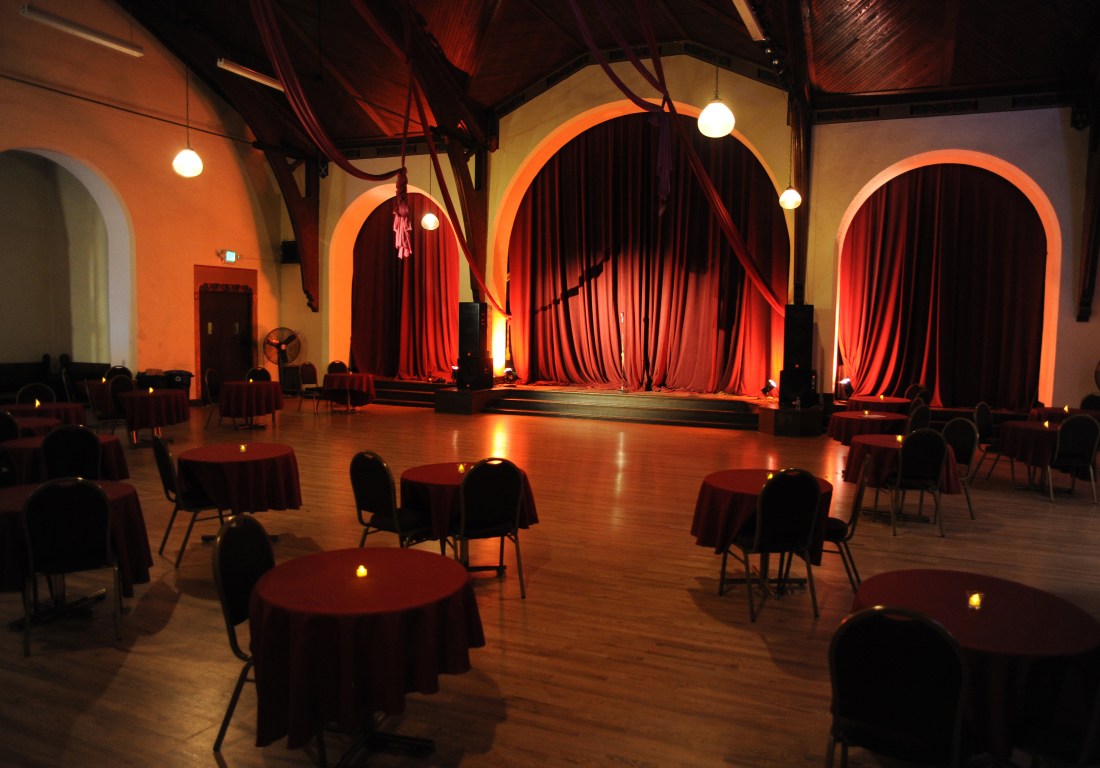
This is the only prepared speech I have ever given, and I wrote the bulk of it a couple hours before we kicked off the final night at the old Ballroom in the Pigtown church September 23, 2023, the day before our 12th anniversary. A hurricane had disrupted the simultaneous programming we had going at the new spot, so our chef and his partner heroically hauled vast amounts of food across the city and set up a buffet just in time. The point is that, while writing this, I periodically rose to run an extension cord or clean up water that had sloshed from a warming pan. This was an appropriate way to close the old girl down–living out, for one more night, the ridiculous, human stretch between idealism and reality. I ended this night so angry and frustrated by the vapidity of some of my regulars that I retired to the office to avoid yelling at them or just closing early, so that should factor into any assessment of what I said. People, myself included, are capable of grace and pettiness in alternate moments. All of that acknowledged, I stand by this speech. Those who know what’s what will be able to tell that I was reading a lot of Marilynne Robinson at the time.

The Speech

Sarah and I have been publicly cagey about why we have chosen to close this place, and I’d like to begin with a short explanation.

About four years ago a rich douchebag came into our lives and tried to use our love for this community and this building to extort us. He promised to forgive a debt we didn’t owe if we signed a ten-year lease. We would have signed a lease for free if he’d just asked us, but people like him can’t imagine working in the absence of leverage and coercion.

If Sarah and I believe in anything, we believe that you should never appease assholes. So instead of quaking in our boots, my bestie and I told him to take his lease renewal and shove it. We’ve been gleefully defying him and his wretched works for four years.

So that’s why we’re moving.

But I don’t want to talk about assholes any more than necessary. I mention him as a segue into a simple fact about you people that someone like him is incapable of understanding.

Mobtown is a community, not a building. I love this rickety old church, but it would be pointless if it wasn’t filled with all of you. This is obvious. Buildings are made sacred by people, and not the other way around.

Here’s what I mean when I say sacred. I want you all to look down at the floor.

12 years ago, a raggedy-ass crew of volunteers started here by the stage and laid this thing out plank by plank until we hit the wall back there by the DJ booth. It was hard work done on a deadline, but I don’t think any of the people who were there will ever forget it. Implausibly, that raft of goons ended up making one of the best dance floors in America.

The building of this floor was a gesture of hope, decency, and generosity–just the sort of thing that happens in countless communities everyday. It’s what people do when they live their lives together.

But that simplicity hides a miraculous result. It is an indisputable fact that right now everyone standing in this room is literally held aloft by that month of work and by the people who did it. The floor has withstood everything we’ve thrown at it for all these years, and it has quietly upheld every experience you’ve had in this room. Many of the people who built it are not here and have no idea we’re talking about them. But what they did persisted far beyond their direct involvement.

Sometimes the things we do for love can last.

The point is that what you do in the world matters. You matter, though you’ll rarely see the full extent of your actions play out. Just as the kindness of those volunteers 12 years ago echoed through the lives of people standing here whom they never met, the kindnesses you have done for each other in this room have afterlives. You have been held up by others. Hold others up in turn. That is all that is required.

It is no secret that I think we are entering a barbarous age, a time in which efficiency replaces humanity, citizens become taxpayers, education becomes job training; a time when even good people find it hard not to soak up the cynicism of the age. When something is said often enough, it can take on the quality of received wisdom. And then it traps us.

This place was meant to defy that from the start. The glorious mob in this room and all of the forms it has taken over the years has steadfastly showed up to look their fellows in the face, to take part in an ancient and human tradition of fellowship, music, and dance. That is powerful precisely because it is ephemeral; it cannot be branded or packaged or turned into “content.” This place is impossible to explain. When it is closed tomorrow, I hope people will say, “Well, you kind of had to be there.”

Whenever this place flourished, it flourished because all of you made the ballroom a sanctuary. A place where you could be human, if only for an evening.

That is a sacred act, a holy act.

The ballroom is something you created together week after week, something you sustained and which will continue to exist long after this poor building has been eaten by rats. Mobtown is made of people.

Whatever Sarah and I do going forward will have this at its heart, and we hope you will join us. But tonight, when you walk out those doors, I would like you to remember what we all built here, and whatever else you go on to do or make, make it human.

You have been held up. Hold up others. Remember that you matter. Remember that the person standing next to you matters. Defy everyone who says otherwise.

As for me, I have spent my entire adult life literally holding other people in my arms. I have the best friend and business partner anyone could ask for. I cannot tell you all how much I’ve enjoyed your strange company. I am a lucky man.

That’s it. That’s my sermon. From the bottom of my heart, thank you for these 12 years.

Nearly Inspired Version 1: Shooting

Through the long years of our alienation, I still visited my father, though the trips had been reduced to coincide with the periodic death scares that measured out his ten-year struggle with colon cancer. Now and then the doctors would tell him that they could do no more. He would make the call; I would book a flight. Each time the doctors managed to cook up some new treatment option of dubious promise, and each time my father proved resilient. In the midst of these treatments, and while he lacked a useful length of colon, he signed himself up for a kind of para-police handgun training. A member of his congregation loaned him the 9mm Glock that the program stipulated, and he took to the desert for four days to fire 1,000 rounds. This was a relief to him, I think, because as he grew older and sicker my father’s fascination with violence increased even as his capacity to participate in it diminished.

We had often gone shooting together in the vast open spaces of New Mexico, which we both loved. Though my father was being swept up in the early stages of the fevered right-wing madness that has overwhelmed evangelical Christianity, his cowboy ethos had not given way entirely to militarism, and shooting was an activity we could still share. So, on one of my death visits, when he suggested that we go out and do a little damage, I eagerly agreed. I thought it might furnish a reprieve from the constant religious talk and my father’s latter-day habit of fantasizing about the way he intended to face his own death. I had served as audience for him in my youth and couldn’t stomach it any longer, even though I could tell that my rejection of his attempts at charm or gallows humor or demonstrative courage hurt him. I could no longer relate to the small set of totalizing religious convictions that steered his thinking, and our conversational scope had shrunk to exclude almost any serious subject. The rigors of his personal faith permitted very little neutral ground. Hence the guns, and hence the desert.


It was very early spring in the those arid mountains. Strips of snow per­sisted in the lee of hills and wherever the wind had gathered it into piles. We had been accustomed to shoot on an infrequently-used access road outside of town that cut into the side of the Rio Grande Gorge. We parked on a landing at the top of the road–a dizzying place where people came to light fires and shoot down at the defunct appliances and ancient cars that littered the rocks below–and we hiked down the road for a quarter mile until we came to a familiar high-walled portion of the canyon. Standing on the far side of the road, with our backs to the gorge, the striated clay of the canyon wall provided a natural backstop. My father had quit smoking and drinking in what he referred to as his B.C. days, and he’d replaced those more egregious vices with an impressive Coca-Cola habit. I had been shooting at plastic 20-ozCoke bottles, which always littered my father’s car, for as long as I could remember. We’d harvested a fair number of these and carried them to the site in a plastic shopping bag. Kneeling in the red clay of the gorge, we pushed the bottles into the earth upside down, reserving a full 2-liter bottle to be shaken and ceremonially exploded in the finale.


My father offered me the first turn, and I plinked away steadily with a .22, making the bottles dance and skitter until the red labels detached and fluttered across our makeshift range. Small caliber guns are easy and fun to shoot, and I was enjoying myself. My father took his turn with the larger gun, a .357, and blasted holes in the loose sand of the canyon wall, missing as often as he hit. He reloaded and fired more and faster. He missed more. His facial tic–that old reminder for me to hide–asserted itself, and a slight but sharp spasming of his hands brought him to a temporary stop. I took another turn while he calmed himself and, when the slide locked back, I looked over to find him staring at me.
“l always thought that I was better at this than you.”
I looked back at him, remembering the last time he had exploded at me. He’d sent a dish flying across the kitchen then whipped around in search of a recipient for his rage. This was how it usually was, coming out of nowhere. I was reading on the couch, and, though committed to never retreating again, I had not yet given up my strategy of calm and (I hoped) infuriating compliance. I set my book down, folded my hands in my lap, and looked back at him, feeling, not for the first time, the desire to do him harm. Whether he sensed this or not, he left the room, swearing loudly. I quietly retired to my own room where I sat on the bed and stared at the wall. We never spoke of these things.


Here in the canyon, the old, familiar, furious stillness, which seemed to form the core of our relationship, gripped me. We stared at each other in silence. I wondered idly if he would raise the gun in his hand and, if he did, whether I would raise the gun in mine. I felt tense but oddly at home, as if threat asserted the intimacy of our connection in an otherwise bland world. The rest of life and all the stodgy boredom of work and reason and doing the right thing receded for a moment in that gorge, and I pondered questions of family: I wondered if my father hit people to wake himself up, or to wake them up; I wondered if, now that he had stopped, he missed it. I wondered if there was still a reservoir of violence in in him, as I feared there was in me.


“That .357 is a beast,” I said, “probably better for shooting bears than for this kind of thing. Let’s set up the 2-liter bottle and see what it does to that.” We stood a moment longer.
“You’re probably right,” he said, and laughed.

I let my father do the honors and the bottled exploded in an orgy of foam. We gathered our debris and began to make our way back up the access road, our tension dissipated by the honest work of trudging. Despite the barrel-chested stockiness that we share, my father had always had a peculiar physical grace, a darting capacity that terrified me in my youth, but on that day he was slow to ascend. The once-red hair and pony tail (a relic of the hippie days for which he had repented) had gone almost entirely white, and his movement, though recognizable, was halting and labored. He had been physically imposing for my entire life, but as I watched him struggle up the hill, a flood of pity went through me all at once, and I felt a strange desire to shield this graying animal from other eyes.


Some years of remission and continued alienation followed that trip, but the next and last time I went to Taos there was no question that he was dying. Overconfident doctors had led to complacency, which in turn had led to a stunning metastasis. They removed a lung to buy him some time, an intervention that still seems wildly implausible to me. He sounded different on the phone, a mind struggling to express itself through a failing body.


As usual, I flew into Albuquerque and made the long drive to Taos with the Milky Way blazing above me. He and I had made the drive many times together on the visits after my mother spirited me to Seattle. I was devoted to him at first; then broken-hearted and terrified; and, finally, bitter and quiet, asking for and offering nothing. As the space between us widened, rendering us incomprehensible to one another, he more or less acceded to the boundaries that my behavior implied, preaching around me rather than at me on our drives. No response was required, and I often wondered, with hypocritical grief, whether he had given me over to the devil.


When I arrived in Taos, I checked into a hotel on the plaza and made my way immediately to the nearest bar, where I sat, looking down at my hands circling the glass. I thought that they had hardened to look much like my father’s, and I thought about what his had done and what mine could do. He had gently, reverently placed his broad palm on the Bible during sermons, beaming with the love of Christ; he had curled that same hand into a fist and smashed my sister’s face. She was long gone–he never met his grandchildren–and so was my mother. Everyone from his old life to whom he owed a duty of care had left for their own safety, and the departure of each reconfirmed in his mind that those who serve god must suffer in this world.


This seemed cheap to me, and still does. I didn’t so much crave an acknowledgement of what he had done (which was hardly in dispute) as I longed for him to undergo the kind of painful transformation that his own beliefs required. My father maintained that he had undergone the brokenness that leads to repentance in private. The rest of us were obliged to respect the fact of his repentance and trust to his authority, which would continue without pause. Our failure to move forward seemed like a rejection of God’s grace to him, and thus, by degrees he associated respect for his authority with the correct worship of God. Like all insane systems, it was efficient and self-contained. I truly believe that I could have forgiven him everything if, for a moment, he had seemed devastated by the harm he caused, if he seriously questioned his right to command us. But authority was bound up with his personality, inseparable from his very flesh. Because he could not bend, our family broke, and he reigned alone and over nothing.


I remember little of the time I spent with him on that last trip–except for astonishment that, so close to death, his absolute certainty persisted unmarred by any sense of our family’s story, as if God’s forgiveness had eradicated us. But I do remember that on the trip’s final day he suggested we take to the desert with his guns. This seemed wildly irresponsible to me, given his condition, so I looked to his wife for approval. She shrugged–what harm could it do?–so we gathered the necessary items, got in the church van, and headed back out into the high desert. As the familiar dusty browns and greens passed by the window of the van (Calvary Chapel emblazoned on the side), I reflected that the tithes of his congregation were sub­sidizing this trip and that few in the congregation would object to its purpose. I also thought that, if any realistic approximation of Jesus were watching us, he would consider the entire affair an abomination. A sense that I needed to pay attention and bear witness, however, interrupted my ironic philosophizing, and I returned to what felt like the sacred absurdity of being present. I felt very aware and slightly ill.


We found a gulch in an otherwise flat and scrubby expanse. My father had scared up some retired bowling pins and saved them, like champagne, for this occasion. We positioned the van with its broad rear double doors facing our earthen backstop and set up shop on the gray carpet of the interior.

The bowling pins exploded terrifically, and we fired at their fractured pieces until we had reduced them to white and tan splinters. My father was enjoying himself, adjusting his stance and reciting elements from his pseudo-police handgun training. The ease that accompanies practiced movement had always calmed both of us, and for a moment I felt kinship with him, but my thoughts swerved again. Here was a preacher of the gospel, mere months from death, relishing explosive power. Did he not understand that violence had ruined his life and grievously damaged mine? Could he not forego the complex of God, power, threat, and force and fix his mind on peace in his last hours?

The orthodoxy of my youth had scared the shit out of me, because, how­ever much certainty was on offer, the promises of salvation were intermixed with the terror of becoming unworthy. I feared “backsliding,” and the church fed me a steady diet of stories about people who had done so. I vividly remember a children’s story about a missionary who, in the exotic locale where he preached (supported by his beautiful and pure new wife), fell prey to tempt­ation and committed adultery with a native. An otherwise unimpeachable life was ruined, and he came back and unwittingly infected his new bride with HIV. The story was racist and medically dubious–basically Victorian–but it was presented with luscious detail. The couple were trapped together with all trust lost, their bodies “burning” with AIDS. The point was that you were never safe, and that the no degree of vigilance was unjustified. You had to fear yourself. There was a lurid glee in passing these stories down to the Christian youth, and, though this stuff smells of the campfire story or the urban legend, we were meant to believe it. It bred guilt and paranoia in everyone I knew.

This guilt expressed itself in strange ways. I don’t know any conservative Christians who don’t share the experience of fearing that the rapture has occurred when they temporarily lost their parent at the grocery store or when they woke up in a quiet house. It is no exaggeration to say that such small events could trigger a visceral fear that you were a secret monster in your family–soon to be abandoned by those you love and doomed to suffer through the impending reign of the antichrist. However silly this may sound from the outside, these strains in fundamentalist Christianity tortured and marred a generation of evangelical youth.

I was trained to see the events and impulses of daily life as battles for my soul’s salvation, episodes in the “spiritual warfare” that constituted the reality behind the bland incidents and events of life. I remember praying desperately for some kind of sign from God that I was among his elect. Nothing. I remember standing during worship at church, trying to generate feelings of awe and devotion, which, as anyone can tell you, is a doomed endeavor. Most of all I feared that I had committed “blasphemy against the Holy Spirit,” a mysterious action that Matthew’s gospel describes as the only sin that God won’t forgive. For me and for my peers, the existence of an unforgivable sin more or less obliterated the notion of God’s forgiveness, because we were never quite sure whether we were at risk of committing it, or whether we already had. This was terrifying, and I put a great deal of work into a series of stratagems, increasingly complex, marshaled to suppress any thought or emotion that might signal that I had crossed that fatal line. Doubt was such a sign, as was the failure to feel God’s presence or feel appropriately loving towards him. Doubt of the entire structure was a sure sign, but even questioning the received interpretations of our modern and ridiculous sect was cause for concern. Thus, I began by wanting to serve God and my fellows, and I ended by policing my own mind until it snapped.

As my father and I stood in that desert shooting bowling pins, I remem­bered all the fears that his religion had inspired, and I meditated–detached, again, from the precise reality of where I was and whom I was with and, in general, why I was there–on how the ghosts of these fears had never left me. Hell as a metaphor haunted me, and my life had been marked by an inquisitional obsession with the correctness of my own thoughts. One could be damned and not know it; one could live in hope, however thin, but live, in fact, as a ghost, separated from grace. But another side of me pushed against this. Was this ghostly state not, in fact, my father’s situation? Surely the secular liberalism that had supplanted my Christianity dictated that abuse of one’s family was unforgivable if anything was. Had my father in effect committed the unforgivable sin and rendered the rest of his life a ghastly facsimile? Was the blunt and hazy grief I felt whenever I was in his presence a way of mourning for a man whose reality had been lost in guilt and attempts to reorder the world to justify himself? He certainly didn’t think so, but that would be, after all, the essential horror of the situation. Even as redemption was passing you by, you would be too blind to lay hold of it. The Calvinists have dwelt much on this.

Again on that day I shook my head and tried to return to the moment. If I wasn’t going to stand on liberal principle and object to the activity and the company and sit right down in the New Mexican dust and rend my garments and protest the state of my life and the world, I might as well stop circling the drain of my own psychology and pay attention. I was, after all, holding a gun. I focused on the dry wind on my skin and weight of the steel and polymer in my hands; I focused on the slow breath I released before squeezing the trigger and the report that contrasts and complements the meditative calm of taking aim. I felt my father there. He was as present as he had ever been, somehow more so, precisely because the the majority of his breaths and thoughts resided forever in the past.

Perhaps we had this in common: we both found moments of violence or control clarifying, if not strictly pleasurable. I know that he shared with me the sense that the majority of life was taken up in navigating mundane practical tasks and undergirded by low-grade anxieties. Even though he had found his way to relative calm, we both considered the actual experience of life, on a gut level, offensively boring. Shooting was good. It was something you could feel in your bones, transgressive and bracing, the kind of thing that reminded you that you were a powerful mammal and not a consumer. For a moment in the desert, we were together, two people obsessed with and trapped by our respective metaphysics, united in the struggle to justify and assert ourselves against necessity. Not once did I think that we might shoot each other.

As we neared the end of the bowling pins’ useful lives, I turned from our range to ask if we had anything else to serve for a target. He couldn’t see or hear me. He was leaning forward against the van, his head on his arm, blanched and quiet. I approached him and gently laid a hand on his shoulder. I suggested we go home, and he nodded. A quiet urgency, which felt like fate, hung in the air. I drove us home, leaving our wreckage of splinters and casings behind.
Back in Taos proper, as I helped him from the van and into the house, he draped his arm over my shoulder in a posture of intimacy that had been foreign to us for 15 years. I briefly remembered how much I had feared that arm, and the idea of knocking him down and giving him a few hard kicks floated across my mind. I settled him onto the couch. His wife was puttering in the kitchen, and she looked unconcerned, which granted me a sense of relief I had not known that I needed. Sitting on the couch opposite him, the mix of rage, grief, and pity I was feeling produced an odd sense of vertigo, and I sat trying to breathe deeply.

After a time, my father’s own breathing slowed, and he seemed more comfortable. His wife was still behind me in the kitchen and the protocol of the situation eluded me. How do you excuse yourself for the last time? Is there a non­-casual way of doing something so momentous? Do you wait for someone to do the excusing for you? Having gathered himself, my father said that he had some videos for us to watch, and he conjured up YouTube on his television, to my great surprise. We spent the next hour watching grainy, black-and-white footage of atomic explosions, tests of nukes going off in the desert of his home state or in the sky or over now-poisoned seas. I struggled to accept that this is how we were spending our last moments together, but when I looked at him viewing these images of apocalypse, his eyes shone, and I let him be. He had preached the end of the world for decades, and there was something to his consistency. It was a fitting end for a fundamentalist.

Power and violence and God had fused together in my father’s heart, and I thought then that his take on religion made a certain sense. God had redeemed him, and what that really meant was that God had redeemed violence, which was inseparable from his nature, for him. The personal acts of violence that had marked his early years were rendered largely unnecessary by participation in God’s vaster scheme, where violence shot through life in a thick, rich vein; a counterweight to whatever hope individual acts of goodness or gentleness might inspire. I shuddered and felt that my own feeble moves toward justice or change could never partake in this potency and, worse, that the part of me closest to my father bore witness against me, hinting darkly that I would come along in due time.

Such were my thoughts when, exhausted by the day and perhaps by the atomic excitement, my father said, “I should be getting to bed soon.” It was 5pm. I got up and gathered my few things. He struggled to rise, and slowly escorted me outside. We stood in the driveway. “I don’t think that we will see each other again,” he said, “thanks for coming out.”
“Of course,” I replied.
“I love you, Michael.”
“I love you, too.”
With that, we shook hands and hugged. The old familiar smell of him conjured a kind of horror in me, but under that was something else. In those few seconds that we held each other–for the last time, but also for the first time in many years–I felt how the necessity of running from him had made me reject every memory of kindness or decency involving him. Having cut him from my life, it felt wrong to cherish any of these memories; it felt like displaying an amputated limb. But this man had taught me how to read and study, how to shoot a BB gun. We’d gone on long bike rides that ended with milkshakes. That I’d also found myself pinned against a wall with him screaming in my face, fist raised–that did not, in fact, cancel out the goodness, though it made the goodness inaccessible to me. That may be as good a definition of abuse as I can summon, being asked to reconcile irreconcilable things. My father had asked for an inhuman capaciousness on my part, and, though I had to leave, leaving felt indistinguishable from failure.

I remembered–or, more accurately, felt–these complexities as I backed my rental car out of the driveway. He stood and watched, his face unreadable, and I labored under the other-worldly knowledge that I would never see him again.

I drove back to the bar and ordered two whiskies and a beer. Then a couple more. Then too much. I attempted to arrange the vignettes that comprised our relationship, but the pieces and fragments of memories seemed to lay on the bar before me, inert. He was a dying minister from a cut-rate, absurd denomination. I was a heathen son at home in neither the church nor the world, half lost in books, with violence in my veins. My father and I had never had it out, never even investigated the contours of our silent truce. This was to be the story of our relationship.

As it happened, we never spoke again. Some months later, when his name lit up on my phone, I knew it was not his voice that I would hear. I let it go to voicemail, got out of bed, made coffee, and sat at my desk, where I called back. His wife gave me the news–an uncomfortable death, but far from the worst–and, after offering each other the customary inadequate platitudes, we hung up. I sat there for an hour, thankful for the early hour and the privacy, knowing that a relationship so intimate as to make the distinction between friend and enemy meaningless had ended.

When you leave the church I don’t just lose heaven, you lose all that heaven implies: a sense of timeless continuity, the thought that–however vaguely you may conceive of it–the ones you love are never lost to you. You lose mystery and the infinite and everyone–both belief and the capacity to believe. To be fair to my father, I think he tried to warn me about this, and perhaps his broad acceptance of force and his eventual worship of power were symptoms of some internal bargain he’d made to avoid ever washing up on the shores of fear and doubt again. Des­peration might have given birth to a certainty based entirely on need, and the ensuing relief might have endlessly reinforced the original choice. I could understand that.

A photo of my father sits on a bookshelf in my home. He’s seated next to my mother, who is holding me as I grin goofily, perched on her leg. We all look happy, though the anger and violence that would blight our family had long since taken root. There is some joy in that picture, and some hope. When I look at it I wonder if any of us would have had the strength or the desire to continue on if we’d known what was coming. It is a mercy that we don’t know how much even the most privileged lives are going to hurt when we embark on them.

When I look at that picture I see the beginnings of myself in the proud lines of his face, the anger and confidence and mercilessness that I both use and resist. These qualities did not originate in our family with him. They go all the way back, having dripped into his life and then into our lives like ink into water, forever mixed in, darkening and complicating everything. This does not absolve my father, but it makes human sense of him, and in a small way the fact that I have not descended into the physical violence that marred him points towards redemption. He was less vicious than his father, and I have been less vicious than mine. Still, progress is a treacherous notion, and when I stare at the ceiling at night and remember, I am compelled to admit that we share an inheritance, my father and I. We each express participation in a greater unhealable wound, a chronic condition that cannot be satisfactorily described with the wan academic terms of my liberalism. Though, I believe in little else, there is a kind of return to my childhood faith in this, a restoration of continuity, and I take some comfort in it. Whatever faith has been lost, whatever degree of doubt must be admitted and endured, whatever hope there may be, I am compelled to say that–with all my heart–I still believe in sin.

10 Years of Mobtown

Somewhere in Mobtown’s third or fourth year, the inevitable happened and it fell to me not just to clean the bathrooms (which I had often done) but to empty out the small trash cans into which the scourings of menstruation are deposited. I had cannily avoided this for years, hoping to maintain my feminist credentials while exposing myself to these biological remnants as little as possible, at least once they had been discarded and congealed. Like all noble pursuits, this battle was a rearguard action, a desperate bid for time. Glorious. Doomed.

My back against the wall, I resolved to undertake the task in the finest tradition of male stoicism. The cans had been unattended for a few days too long, and I felt bad about this, as I had often had occasion to lament the state of the bathrooms after a well-attended event, wondering how it was that people had the time or interest during a night out to make confetti of so much toilet paper and let it snow down gently across the tile. Perhaps they were angry about the full cans, I reasoned generously. Buoyed by these benevolent considerations and having dispatched the first can with fortitude, I placed a cautious toe on the pedal that would activate the lid of the second, paused for a beat, and pressed. Leaping back, I yelped, and the can’s lid snapped shut on what appeared to be a mid-sized gray mammal, alive or dead I could not say. 

I retired to my safe space behind the bar and fortified myself with a dram of whiskey before facing the problem in the steady and objective manner that is the adornment of small businesspeople everywhere. If, as seemed most likely, the animal was dead, I had to dispose of it, and a handy pair of tongs would likely do the trick. If, on the other hand, the animal was merely dazed or wounded, prudence dictated that I use the plastic slop bucket and colander from behind the bar to outflank and trap the intruder before releasing it into the wilds of Pigtown. 

So it was that–armed with bucket, colander, and tongs–I made my way across the expanse of hardwood towards the bathrooms. A second dram of whiskey steeled my purpose and warded off incipient puritanism. I struggled to put certain haunting questions out of my mind. Was this animal a pet? Was its placement here in the ballroom in my own menstrual cans a misguided attempt to responsibly dispose of roadkill? Had the animal somehow stepped on the pedal and activated the lid, opening its own tomb? Worse yet, had it been used for some wildly inappropriate, grisly menstrual purpose and then, strange to say it, been appropriately discarded? These were the questions as I approached the relevant can, caught between pity and horror. I toed the can again, ready to swoop with bucket and colander should the mammal show twitches of life. But there were none. I jostled the can gently. Still nothing. Switching to the menstrual tongs, and whispering a prayer to whatever wretched god presides over such things, I laid hold of the furry mass, clamped it firmly, and pulled from the sepulcher of the can a coon skin cap, tail and all.

***

How this Davy Crockett cap came to be in the Ballroom and how it came to be disposed of in this strange manner is one of the establishment’s abiding mysteries, which are legion. This kind of thing is characteristic of the service industry as a whole and of every off-kilter, screwy job I have ever worked. You can eyeball human behavior pretty well in such places, and it is genially and hilariously discussed by the workers who do the eyeballing, as anyone who has waited tables or worked in a kitchen can attest. Over the years incidents accrue and a place becomes a spot with an internal culture that is distinct from, though intertwined with, the experience of the people who go there. The service side of the bar is a world unto itself, as is managing the show. These roles give you a flipped view of your community, like looking at a photo negative, particularly when they happen at night. There are many drawbacks to that life, but it’s hard not to romanticize it. Turning the lights off in a place that was filled with life and activity a mere hour ago is a melancholy, lovely feeling. I’ve never gotten over that. 

I have been lucky enough to work in such places for my entire adult life, places where you can share a drink or a cigarette after hours and decompress or run out the door to make last call at Club Charles or CVP, only to trade stories and talk shit with people who have left their own service gigs for the same purpose. You drink in a weird kind of life when you work at the places people go to unwind, and if you work at such things long enough you become unsuited to the office world of best practices, metrics, meetings, and memos. For me, that is a happy thought, and—despite the unspeakable volumes of horseshit we’ve dealt with in the past decade—I have loved running this place. I have felt like a human here. 

What follows is a baggy assortment of thoughts and stories about my experience at the Ballroom. I don’t anticipate that they will be of any real use, but they have become precious to me over the years, and I collect them and turn them over in my mind and chuckle at them or groan. Small treasures. Perhaps they may be of some interest to the many strange people who have, in their wanderings, taken some time to haunt this place. 

***

Early on, before we had a bar, one of the staff behind the counter waved me into the vestibule where people pay, and I boldly entered, ready for trouble. A man was leaning against the ticket window demanding entry and languorously eating a thick mayonnaise sandwich. The condiment had squeezed out between the slices of bread and caked his hands, arms, and shirt. Opting for honesty, I told the fellow that he appeared very high indeed and could not come back until he was sober. I asked him if he would go outside to talk with me (an old trick), and he consented. As I walked him out the door and across the alley, thinking myself very clever, he turned with surprising deftness, punched me in the face, and pushed me in front of a car turning down that same alley. 

The cops were, as chance would have it, idling across the street. They cuffed the man and seated him in that dejected position on the sidewalk that they love so much, and then asked me if I’d like to press charges. I said no, but asked in turn whether they could take him somewhere to get help, or, barring that, whether they could drive him somewhere far off and drop him there to give me time to close before he could return and resume hostilities. They informed me that the first option was up to him (he declined) and that the second violated his constitutional rights (which was fair enough). So the man was uncuffed, and he disappeared down the street. The cops left. 

This not being my first rodeo, I went back inside to grab our crowbar. As I remerged from the Ballroom’s solid red doors, my worthy assailant was already making his way back across the street. I held the crowbar above my head with both hands like John Cusack in Say Anything and gave it a few tight shakes. The pugilist stopped and stared. A long intimate moment passed before he turned and made his way into the night. I walked back into the Ballroom, wondering whether we should make a policy for this kind of thing. An attorney friend informed me that I was probably within my rights to hold a crowbar but should avoid “brandishing it.” If any other wisdom was gleaned from the experience, I have forgotten it. 

***

Any number of felonious/hilarious misdeeds have been perpetrated near or against me since this place kicked off. Once, sitting outside the ballroom and looking at my phone, I was shocked to find it raptured out of my hands by a nimble bicyclist who was down the street and well out of reach before I had the chance to object, much less make the reasoned argument that I could have just given him cash, saving me a hassle and increasing his profit. This was some years before another bicyclist, on the exact same patch of sidewalk, punched me in the face as I stepped aside to let him pass. There has been more punching (of me) in this job than I had anticipated.

Not long before the pandemic, a customer approached to say that her bicycle—which had been locked to the green rack just outside the door—had disappeared. I accompanied her outside to investigate, and found that not only was the bicycle gone, but the lock had gone missing as well. There was no evidence that a bicycle had ever occupied the lonely spot. I stood there scratching my head, then leaned against the rack to adopt a jaunty conversational pose. The bike rack fell clattering to the ground, and I nearly took a spill myself. The enterprising thief had removed the bolts holding it to the ground, and then carefully replaced the rack itself. This is as good an illustration of the difference between a workman and an artist as I can conjure, and I often think back on the incident with admiration. 

By way of digression, I have to say that bicycles have been one of the great annoyances of my professional life. Something in the makeup of the bicyclist includes the confidence to ask if they can bring the damn things into the Ballroom, and, of course, any answer in the negative elicits the most pitying and self-righteous of environmental gazes. I often fantasize about buying a bicycle, covering it in grime, and bringing it to the living rooms of these people, where it can tip over, smash things, block fire exits, and raise their blood pressure.

Before I leave the subject forever, I have to say that a scampy young regular of ours has fired off a new salvo in the bicycle wars. He has taken to showing up at the ballroom on an electric unicycle (what abominations will I not live to behold?), and I have struggled to make my objections to this contraption rational, since, being no bigger than a backpack, it is stowable beneath a pew. Still, I object to the wearing of backpacks as much as to anything else, and the goddamn thing looks, when not in use, exactly like a giant Roomba. Explaining why something like this raises my hackles (and should raise yours) is an exercise in tautology. I do not know when style and grace will return to the world, but, when they do, people will not be sailing down the street on Roombas, I can tell you that much. 

In other felonious happenings, our safe has been stolen twice, despite alarm systems and every reasonable precaution. There’s never enough money in it to make the Spiderman-style hijinks required for these thefts remotely worthwhile, which makes me question what percentage of criminals actually operate at a loss (and whether, on the way home from unremunerative heists, they console themselves with platitudes—better luck next time, at least we did our best). During the first such theft, a duo of thieves departed the building with a large gun safe that we’d gotten on discount at Cosco. They dropped the thing repeatedly on their way out, and the sidewalk still bears the scars. We thought that would be the last we’d ever hear about it, but about a week later, the police told us that it had been dumped on a boat launch in the harbor. I made the trip down and found it there, half submerged, with a perfectly circular hole cut in the top of it. The waves lapped at its sides, and warranty documents drifted slowly out into the Chesapeake. 

***

The internal operations of a skeleton crew organization like this are as chaotic and whimsical as anything that comes in off the street. Sarah Sullivan, for example, has a habit of playing pranks on me, must of them calculated to feast on my deepest insecurities. Under normal circumstances, this would be cruel, but I suspect that the way I present and carry myself makes it a necessary corrective. One notable day, as I was driving towards the ballroom with our old monstrous business partner (of whom I have spoken at length elsewhere), I answered the phone, and a woman with a British accent told me that Sarah had listed me as a reference, and that she was very excited about hiring her. My heart sank at the thought of running the place with the monstrous partner, but I know when to rise to the occasion, so I collected myself and gave a stunning reference. Sarah, I said, was someone we would fight to keep and someone to whom they would, if they had any sense, make a very generous offer. She was a powerhouse, a self-starter. She identified problems before they were problems. That kind of nonsense. Having arrived, I entered the ballroom to find Sarah grinning at me–and her mother, Cindy (who had, for some reason, improvised a British accent), cackling on speakerphone. My goat had been gotten and Sarah had extracted some compliments in the bargain.

Once one of her pranks backfired, or, at the least, left me smelling like roses. At a New Year’s Eve event in North Carolina, Sarah had spent days crafting a particularly devious act of wickedness. She intended, she told me over drinks at the bar, to propose to Charlie at midnight on the 31st. She was finally ready; she’d made her decision and was eager to move forward with the next stage of her life, etc. Naturally, I rejoiced at the news that my two beloved friends intended to take this step together, and I pledged my support and silence on behalf of the worthy project. On the fateful evening, a half hour before midnight, Charlie took me aside and asked me for a word in private. I escorted him outside the hotel ballroom and around the corner. Our breath rose in the late December cold. 

“Michael,” he said, “I think Sarah is going to propose to me tonight.”

“That’s wonderful, Charlie. Why do you look like someone stepped on your tail?”

“I love her, but I’m just not ready.” He looked pained in a way I had never seen, and I could feel the earth moving under my feet. I did not want to see this relationship fail. I resolved to say as much. 
      “Charlie, I’m sure that Sarah can wait if that’s what you want, but my formal advice is that you have a good situation on your hands. She’s great; you’re great. Both of you have too many foibles to be good for many other people. This shit works and makes a kind of weird sense. If you don’t want to be with anyone right now, then cold feet would make sense, but, otherwise, I think you’d be an idiot to hold out for something better. It’s not coming along.” Charlie looked at me for a long moment, thanked me, and we hugged. He went back in ahead of me. 
            I took a couple minutes in the cold to reflect, and made my way into ballroom. Sarah was already running towards me, bellowing, “IT WAS A JOKE. WE WERE SETTING YOU UP.” Charlie, it turns out, had returned to the ballroom and suggested making their mock engagement real, lest my heartfelt speech go to waste, and Sarah was having none of it. Both of them looked harried and confused when they had meant to harry and confuse me. It was wonderful, and I have long treasured this memory of my friends’ discomfiture, thinking back on it when I am feeling low. Recordkeeping of this kind is crucial to the maintenance of long-term friendships. 

***


Sarah and I have spent a more than a decade of our lives torturing her husband. Before the ballroom opened, we made him carry the sound equipment to venues we rented, a duty he performed for love. I have used him in some rather mischievous alcohol experiments, snuck up on him when he was alone singing in the ballroom, stolen his phone, and sat on his shoulders and insisted that he run laps around the ballroom to Chumbawamba’s Tubthumping (a form of dance training the efficacy of which Charlie’s abilities bear out). Years ago, Sarah and I were talking business on a group text that included Charlie. I was in the office, and Charlie was in the Ballroom teaching. I could hear the first message I sent bing loudly in the main room, as Charlie was using his phone to play music for class. I said as much to Sarah, and we both began texting “bing” to one another, as quick as we could type. I opened the door to the ballroom. A chorus of bings was pouring from the sound system. The students were laughing, and Charlie was pacing back and forth, waving his hands in confusion. His eyes landed on me. 

“Goddamit, Michael,” he said. 
I can run with Charlie stories. He once loudly and insistently referred to his “hymen” at a bachelor party. A hush fell over the room, and, in a moment of rare and absolute male psychic connection, the other attendees and I looked at him innocently, as if we hadn’t heard. “My hymen!” Charlie said, “my hymen!” We held it together long enough for the tragedy to dawn on him, and, when recognition flooded his face, the room erupted with laughter. Charlie’s hymen has been a watchword ever since.

These stories make me very happy indeed, even as retelling them reminds me that the world has changed and the era of people expressing affection with torture has come to a sad end. Charlie, to whom these things do not come naturally, has bravely and cheerfully undergone all manner of indignities from Sarah and me. He has done every job at the ballroom, even the ones he most despises. When I left the monstrous old partner and slept in the ballroom, Charlie, drunk as can be, abandoned his birthday date with Sarah, and rushed to my aid in a cab. Our conversation was understandably less than useful, but he was there, and it took the edge off. These are things you remember. 

I’ll say one more thing about Charlie. Way back before the ballroom, Sarah and I were running an event in a former gym turned African dance theater, which we rented on Fridays. The place was not well-marked, so we sent Charlie outside in a sparkly sequined jacket that I’d stolen or inherited from somebody’s grandmother. He had a large sign to guide people into the parking lot, and his task was simply to stand there and let the sign do its work. I came out to inspect him an hour or so into the event. He was standing manfully at his post, talking to everyone who pulled in, welcoming them with sincere interest. That has been his way for more than ten years: He takes care of people. Conversations that I would end with terrible, rude swiftness, Charlie abides, seems almost to enjoy. Sarah once asked him how he pulls this off, and he replied: “When it starts to get annoying, I just ask them to dance.” 

***


And, God help me, it does get annoying. A public venue is bound to bring in some originals, but no amount of experience makes the insanity of the public less baffling.

     “Hi,” someone recently said to me, “were you aware that there is no parking tonight?”

     “No,” I said, feeling puckish, “where did you put your car?”
     “I parked it.”
     “Oh.”
     “What I mean is that there is very little parking.”
     “I’m sorry.”

     “You should look into it.”           

 “You are drastically overestimating my powers.”

Or, one of my favorites: 
     “Are you going to ask the band to play some blues music tonight?”

     “Buddy,” I replied, leaning across the bar, “this is blues music.”
     “No, it’s not.” 

     “It’s a blues band. It’s in the name, ‘The ______ Blues Band.’”

     “No, this is Lindy Hop music. It’s fast.”
     “Lindy Hop is not a kind of music. And blues is a form not a tempo. Seriously, I know what I’m talking about. I promise.”
     “You’re the bartender.”
     “This is my venue. I hired the band.“

“I’d like to talk to someone who knows what’s going on.”
     “Wouldn’t we all. Let me introduce you to Sarah.”

Anyone in the service industry can tell you that people out for an evening of entertainment—otherwise decent, lovely people—lose all sense of boundaries around service folks at work. A particularly goofy regular of ours who has a habit of taking up more than a reasonable share of my time directed his steps towards me a month or two before the pandemic began. I’m wise to this, and adopt what some of the youngsters here refer to as my “there’s a fire somewhere” walk, a purposeful, no-nonsense gait I assume when I do not wish to be stopped, buttonholed, or otherwise hectored. In this instance, my would-be pesterer was undeterred, and I took the drastic step of fleeing to the bathroom, assuming a private and sacred position at the urinal. This terrorist of the mind followed me in, and I could sense him behind me, waiting for me to finish. Boldly, I resolved never, ever to stop urinating. I underestimated the tenuousness of this man’s connection to decorum. He piped up: 
     “I didn’t get a receipt at the door.” Is this happening? I thought. It was. 

     “You want a receipt for a cover charge?” I asked, craning my neck to address him.

     “Yes. It is for my financial records.”

     “Quite right. Situated as I am—here, at the urinal—what is it you would like me to do about it?”

     “You have a POS system. You should really give people receipts.”

     “What can I do to end this conversation immediately?” I queried firmly. Charlie, by chance present in the bathroom, guffawed.

     “You can give me a receipt.”

  I was in too deep. “Fair enough,” I said, “please retire to the bar while I finish my ablutions, and I will be with you shortly.” 

This odd fellow left the bathroom, and Charlie grinned at me wickedly (feeling no shame, I might add, for  having failed to aid a ballroom operator in distress). I shot him a dark look, and went to the bar where—standing next to highly-competent staff that could have printed a receipt—I printed a receipt. 

            “Thank you,” the mental terrorist said. “You should really give people receipts.” 
            “Jesus fucking Christ.”

Speaking of urine—we once hosted an extremely over-the-top fundraiser for a beloved local musical organization renowned for doing extremely over-the-top things. I knew that it was  the kind of event where shenanigans would be the order of the day, and I thought our team well-prepared. The group hung an enormous car-sized papier mache skull from one of the circus points; they lit and festooned the ballroom in a stunning manner, and commenced to throw one hell of a party. Midway through one of the band breaks, I stepped outside for a little chill air, and, behold, some hipster attendee was across the street, pissing against a neighbor’s house. This kind of thing, aside from being wrong, is not great for business or our relationship with the community. I ran across the street to upbraid the young idiot and was intercepted by an elderly black pillar of the neighborhood on the same errand. This man had given us the benefit of the doubt when we, a handful of white children, came to the neighborhood to open a venue. He had supported our rezoning when we needed it, and he had backed us when we needed the community organization’s approval for the transfer of our liquor license. In short, he had gone some considerable distance on our behalf, and what we were presenting to him in return was far from what he, and the neighborhood, deserved: a white man producing his dick in public, pissing on black housing. 

“I cannot believe what I am seeing, Michael,” the pillar of the community said. 

This cut me to the heart. I apologized sincerely and deeply as the hipster weasel looked on, smirking. While our august neighbor stood there, I went back inside, waded through the crowd, and got a bucket of soapy water and a scrub brush. I returned and cleaned the hipster’s urine from the housefront while he continued to look on stupidly. One of the organizers of the event got wind that something untoward was happening, and she caught both me and the douchebag walking back towards the Ballroom. 
“Fuck that guy, right?” said the hipster shit. 

“On the contrary, fuck you,” I replied.

“What happened?” asked the organizer.

“This little shit is not coming back inside. That’s what happened.” The organizer hemmed and hawed for a moment, understandably confused by my mystic utterance. I took up a stern and forbidding stance in front of the door. The douchebag stood about a foot in front of me. 
      “I’m coming in,” quoth the skullduggerous shithead. 

“If you manage to come in here, you will never be coming back out.” 

The hipster shit stared at me menacingly. I stared back, inwardly complimenting myself on saying something awesome. After a few deeply stupid, masculine moments passed, he turned and walked down the block. The organizer informed me that he was in the band and that all of his equipment was inside. I helpfully replied that anyone unfortunate enough to be associated with this trouser snake was welcome to collect his equipment for him and deposit it on the sidewalk. By this point I had partially let down my guard, and I stepped aside to let a customer approach the doors. I noticed that he was wearing a coat buttoned unseasonably high and one of those winter hats with the ear flaps pulled down. I leapt forward in the nick of time, for it was the douchebag returning in disguise. 

This is the second story I have involving a furry hat. 

***

            The hostilities above have crossed my mind often, because the turn toward the comic in otherwise heavy, serious interactions has been repeated time after time at the Ballroom. The douchebag in question represents a large portion of what I hate in the world, but how can I help but laugh at the audacity required for him to return incognito? Many of the villains we’ve encountered have had their comic edges, even those who hurt us most deeply, and something in me balks at the thought of denying or overlooking that. Like my fellow lefties, I will engage in the odd bit of internet moralizing, and I foam at the mouth with the best of them; but, God help me, if I ever do my foaming without a twinkle in my eye, or if I ever fail to preserve some shard of love for the disguised pissers of the world, I hope my loved ones will have the good sense to cudgel me to death. 

***

            Conflict has shaped the Ballroom and shaped our experience in this city in a way I never anticipated. In the early days we were overly-cautious in dealing with what we now understand to be garden variety malefactors. We have kicked many men out of the ballroom, and a healthy handful of women–at first after long discussion and consultation and eventually with the easy confidence born of experience. These days they are easily sniffed out, and we have a better sense of how transgressing small boundaries invariably leads to transgressing large ones. A warning is given, then ignored. Then we kick people out. The wicked set begin by negotiating and wheedling, but they are too addled by the conviction of their own charm and “rights” for this to last long. Confronted by our absolute unwillingness to hear them out, disbelief gives way to rage. They threaten and wheedle by turns, trying on different approaches, and growing more distraught. The type to need the last word, they tend to leave on a threat, usually some foggy promise that we will be “hearing from” their attorney. I suspect that there are not enough attorneys in the world to represent all the male software engineers who have appealed to them in a rage. 

The course of these interactions is depressingly predictable, and we’ve found that the only appropriate approach to douchebags is all-out obstinate resistance. It kills this sort to be stood up to, and they show their true colors pretty quickly. There is good fun to be had in needling them if you have the stomach for that kind of thing. I used to delight in it.  Over time, however, I’ve grown to feel that justly resisting people who would compel you to do something or who would use you for their own self-aggrandizing, abusive purposes is still itself a kind of force, and using force gnaws at your soul. Both Sarah and I have grown weary of this stuff (though we are as obstinate as ever), which I take to be a sign of health. We don’t like hurting people.

Sometimes things have gotten dicey. I wish more people—particularly people whose primary experience of conflict is displays of nobility on the internet—understood the true cost of dealing with douchebags in a professional capacity and the sometimes physical courage required. When we successfully handle a situation, the injured patron moves on, but we tend to hear from bad actors for a long while after. We still get the odd threatening message or phone call, the occasional suggestion that people are watching. I have one who has been calling me for years and another who constantly tries to harass me through third parties. Sometimes I run into these goons on the street. I occasionally wonder when someone we take to be a manipulative weasel will turn out to be violent (I leave out the occasional street punch). The national community has failed pretty spectacularly in these conversations, more or less declaring that organizers should deal with these things and papering over real concerns with a marrow-deep belief that the correct policies will render the world safe. 

I have never quite been able to pin down my discomfort with the urge to offload all responsibility onto organizers and venue operators—with the paradoxical liberal wish for authority figures in general (why, oh why, would we wish to mimic this vilest aspect of conservatism?). Part of it has to do with the unavoidable fact that the desired qualifications would preclude anyone with mental illness or a history of trauma or anything but an inhuman lack of foibles from doing any organizing at all. Sarah has often observed that she is encouraged to be a nuanced, complicated woman right up until something sticky happens. Then woe unto her if she fails to perform as a steely-eyed enforcer of policy on behalf of a shifting liberal consensus, newly minted on Twitter that day. Hesitation, doubt, or even thought is taken as insufficient commitment to orthodox. People who stand by in their own workplaces for reasons of practicality or fear, expect unstinting, heroic action from her. 

I think that all of this may be symptomatic of a dangerous desire to carve out authority figures and parental substitutes wherever one can, and I am convinced it’s a cancer in liberalism.  The conflicting claims of justice in a given scenario—we want venues to be affordable, but we also want to make sure the musicians get paid fairly, but we also want the equivalent of a full-scale HR department, etc.—should teach us humility. We live and die taking these problems one at a time and doing our best. Anyone peddling grand solutions or is a fool or a villain. There is no replacement for a community willing to take care of its members and welcome in new ones. Heroes and leaders are a distraction.

I have veered far into preaching, and will add only that the majority of my beef (and I believe this is also true for Sarah) is with the national community. The folks at Mobtown—even when they are batty as all outdoors—have shown real gumption in creating a community that reflects shared values. When issues are passed on to us it is, more often than not, the result of unnecessary deference rather than a desire to avoid responsibility.  I am very grateful for that. 

***

For the most part, I have tried to deal with conflict like an adult, but in one sphere, and one sphere only, I have given full scope to my hostile disposition and love of confrontation. All cities are filled with scammers and flimflam men, but a city like Baltimore produces a rare caliber of swindler, and these it has been my delight to torture. Baltimore Gas & Electric scams are the worst of the lot, preying on the most vulnerable, and I have done everything I can to make these callers cry. I once told a scammer that I hoped he and everyone he loved ended up “eating rat shit in hell,” and the ballsy bastard persisted in trying to con me.  Most of the time, they try to maintain a veneer of professionalism, but occasionally they seem truly hurt.

Some years back, I looked up how to report these goons on the BG&E website, and was impressed to be referred to an FBI line. A friendly agent said that I should try and play along to mine for information, and, as this seemed a pleasant sort of change from my usual verbal warfare, I made the attempt. The next call proved to be a doozy: 
     “Hi, this is a courtesy call from Baltimore Gas & Electric. You have unpaid utility bills, and technicians are on their way to disconnect your electricity.”
     “Oh, my,” I replied, “I had no idea. Is there any way I can keep this from happening? I can totally pay.”
      “Yes, but you have to act quickly. At this stage in the process we cannot accept an online payment.” 
      “What should I do?”
      “You can pay by cashier’s check. We have a box at a nearby 7-11 where you can deposit payment.” Nothing suspicious here.

“I’m sorry—I have no idea where to get a cashier’s check.”

“You can get one at the 7-11.”
      “That sounds really complicated. I have cash. Can you tell me where I can meet you, and I’ll pay you in person. I’ll kick in a little extra for your trouble. I just really want to get this taken care of.” I may not be the world’s greatest actor.
      “Do you want to suck my dick?” I admit to being taken aback.
      “Do you want me to want to suck your dick?” I began to fear an infinite regress.

      “You sound gay.”
      “I’m beginning to doubt that you’re calling from BG&E.” 

***

It is not, of course, all villains and douchebags, even where conflict is involved. One of my proudest moments, and one of the stories I most enjoy telling has to do with a kind of douchebag apprentice brough back from the brink. Early in the Ballroom’s history, a confident, beloved young woman approached Sarah and me to make a complaint. A young man her age had, she said, been engaging in some harmless flirting with her and a group of friends, when, through ineptitude or malice, he had raised the stakes with an overtly sexual proposition. Whether or not this was offered in earnest was impossible to determine, but we were given to understand that the conversation took a gross and inappropriate turn. He had been handily chastened by the young woman, but she thought we should know. 

      “Is this a kick him out situation or a talk to him and keep an eye on him situation?” I asked. 

After a moment’s consideration, the estimable young woman replied, “I think it’s a talk to him and keep an eye on him kind of thing.” Sarah and I played rock paper scissors to determine which of us would deal with the goon, and it fell to me. I surveyed the miscreant from a discrete vantage. He was wearing a choker, but carried himself with a haughty fake confidence that read: Bro. Something confusing and unfortunate was happening, an unintentional genre mixing. I made my approach.

“Hi, I’m Michael. It seems like you have gone and made a whole bunch of people uncomfortable. What are we going to do about this?” We find it best to come out hard and leave these folks on their back foot. 

“Yeah, I screwed up. I apologized, but it was kind of uncomfortable. I should apologize again.” Interesting. I sensed unexpected sincerity rising up from within the circle of his choker. 

“Would you like to understand what you did wrong?”

“Sure.”

“You raised the stakes; you went from zero to 60. That kind of thing is best left in the hands of people, other people, who have the awareness to tell whether or not someone is inviting a more intense interaction.”

“That makes sense.”

“You are now forbidden from escalating situations. It’s fine to flirt with people, but since it’s going to be amateur hour for a bit, it’s your job to let them drive, and, with each response, come in right under wherever they left it. Follow them up the ladder of intensity. When they stop, you stop.” I illustrated this with my hands held out, palms down, moving each above the other. Maybe he was a visual learner.

The young man looked at me as if I’d invented fire, and he seemed to be genuinely relieved at the prospect of interacting with women and keeping his whiskers unsinged. There was no evil here, just dangerous stupidity. Sarah and I checked in from time to time, but we never had trouble with him again. He stopped wearing the choker, which was a relief to everyone.

***

We’ve had any number of such small scale successes, which we consider part of our job, since subculture communities really do function as finishing schools for the socially awkward. Some of the failures, the people we’ve tried to work with and ended up kicking out, however, have been immensely painful. Some of them were friends, some of them highly successful, promising people whose vanity or insecurity made them weasels. I don’t think that the human capacity to start well and end badly through exhaustion or bad company or poisonous ideas has been sufficiently discussed, and we have tried to maintain compassion even in the worst circumstances, despite the tendency among our fellow lefties to mistake hatred for ideological commitment. It is hard to keep someone’s humanity in mind while you move staunchly against them (and they don’t tend to recognize or appreciate the effort), but I’m not sure what else to do. 

Over time, being on the lookout for bad behavior has become habitual, and we have struggled to keep the attitude from spreading out into daily life like an invasive plant. I know that both Sarah and I have had long stretches in which we walk down the street and look at the people passing, thinking: creeper, diddler, idiot. The national dance community seems to combat this by balancing cynicism with effusive hero worship of a rotating cast of types—black women, trans people, women who lead, men who follow, and on and on—people who, however deserving of recognition and power, can never rise to the level of responsibility the community is so eager to foist on them. The intensity of the hero worship is equaled only by the intensity of the hateful glee that surfaces when any of these paragons shows a scintilla of human frailty. We’ve seen too many people praised whom we know to be villains or merely average-grade shitheads or self-serving weasels to go in for this kind of approach. We also know that, like everybody else, our worst moments wouldn’t bear much scrutiny. All of this is to say that, without a counterweight to the sense that we are always on watch for some kind of wickedness—without hero worship to provide meaning and direct ambition—it has been difficult for us, at times, not to despair. 

In this frame of mind, I like to lurk next to the sound booth at the back of the ballroom and take in the whole thing, the unbelievable sight of people dancing, laughing, hugging. In those moments there seems to be a sufficiency of goodness in how people can gather for an innocent purpose, how they plant themselves in a seemingly random place, form relationships, and start conjuring meaning as fast as they can. This beautiful tendency is entirely unmitigated save by the corresponding truth that one act of bad faith or selfishness, one damaged person with even prosaically bad motives, can do incalculable harm. The great mystery of daily life and community—and the reason for all the bravery that people exercise with such regularity that it goes unnoticed—is that the work of a year, a decade, or a century can be undone in a moment.

I struggle with that every day, as I think most adults do after a certain age. I have spent 10 years in this room, working and failing and trying to savor the occasional triumph. I’ve had the honor of watching people grow up, get married (often in the ballroom), and have children. I have seen acts of contempt and self-indulgence, acts of corruption. I have watched people become the best and worst versions of themselves, and I have darkly meditated on how little I had to offer one way or the other.  

***

So much of community has nothing to do with change or progress, I think, and I always smell marketing dreck when people talk that way (including when I talk that way). It is more accurate to describe communities at their best as providing solace, as venues where one’s confusing existence can be witnessed, which is no small thing. Life is coming to get all of us, and it is best to face that fact in company. Some of you may remember that a good man died in this room some years back. I won’t insult the bereaved by talking about what that long night meant to me or how it felt for the entire staff, but I can say that I was tremendously proud of the grace and dignity displayed by everyone in attendance that night, from regulars to first-timers to the band. There was nothing anyone could do—although those who were qualified tried—but the quiet care and love in the place were palpable. If it had been me on that floor, I would have considered myself well served. The awful fact of the thing remained, but its context made it human. 

***

Looking back over this, I see that I have hardly mentioned dancing at all, which makes a certain sense since both Sarah and I have been outliers who have always seen organizing dance shit as a way of getting at something else entirely. I have been dancing since the previous century—and I traveled and competed and even taught a little—but from very early on I understood and was struck by the power that social dancing has to create community, and that has always been what this is about for me, despite my prickliness and hostile disposition. It has been no accident that I, a pastor’s kid, ended up presiding over weekly gatherings in this church. As I said, there seems to me to be something holy that happens whenever people gather for an innocent purpose. I often laugh to think that, out of my cohort of college friends, I should be the only one who took a path entirely outside of teaching and the academy. They have gone on to lead successful and deeply decent lives, and I am still lurking in these odd shadows. I have found meaning in this small work. I am proud of my friends and content with what I have done. An enviable position, overall.

A word on my hostile disposition. The other day I did some back of the envelope math, and was amused to realize that—despite how little all of this has had to do with dancing for me—I have taught a staggering number of dance classes since this place began, and I have been dancing around at our events for thousands of hours more. I have generally worked the room and asked people to dance and said yes when they have asked me. This makes it indisputable fact that, despite everything about me, I have spent the bulk of my professional life not just interacting with people but literally holding them in my arms. Thousands of them. This is both wildly implausible and absolutely true. 

When Sarah wants to make fun of me, she reminds me that I am, technically, a dancer. 

***

This is not what I will be doing for the rest of my life, and from most angles it does seem like a frivolous pursuit taking place in what the uninformed would consider a backwater. We have, however, maintained our independence, operating as we see fit and preserving generous scope to fight the battles we thought worth fighting. Even in a narrow field you can learn a lot by removing the bumpers. There was no boss or board for us to blame for our failures or whose policy we were required to enforce. We simply made up the rules as we went along, trying to act in good faith. This is incredibly dangerous and prone to abuse, of course, and we have often failed. Still, when bad actors or real estate speculators or downright weasels have crossed our path, we had the independence to fight back as hard as we could, and I count it among the treasures of my life that we sent quite a few yelping back out of the circle of our influence. In the bad old days, when our original, wicked business partner betrayed the community’s trust and put the place at risk, Sarah and I did everything we could to put things to rights. Sarah, in fact, did more than anyone would have the right to ask. 

What it has meant to me to work with the best of friends and business partners all of these years goes far beyond anything I can express here. I will only say that more than half of what is best in this place is due to her. At the beginning of the pandemic, when I asked her if we should take out a gigantic personal loan to keep the place afloat, she was game, as I knew she would be. As she always has been. They don’t make people any better or more daring.

***

This community has never let us down. Not once. It raised money for us at the beginning of the pandemic, then again for artists (The Mobtown Telethon!), and then again for the Georgia senate runoffs (Baltimore Saves America!). No call for help or volunteers has ever gone unanswered since we all got together ten years ago and built the floor, plank by plank. Members have testified in court on their friends’ behalf, comforted one another in grief, funded pet surgeries, taken one another in, and danced their hearts out. We have tried to measure up to that kind of staunch consistency, and I believe I can say that we never disgraced ourselves. We tried hard to do right by the community, and we have worked with a great number of people trying to do the same, which was an honor. I do not know what will come of all of this as we move forward, but I do know that I believe as strongly now as I did in my younger, scrappier days that if you put a bunch of people in a room together and tell them that magic can happen, they will make it for themselves. That is one of the oldest truths available, and I have spent most of my life leaning on it. What a way to make a living. Thanks, everybody.